
“All good things in life are fragile and easily lost.”
Indeed.
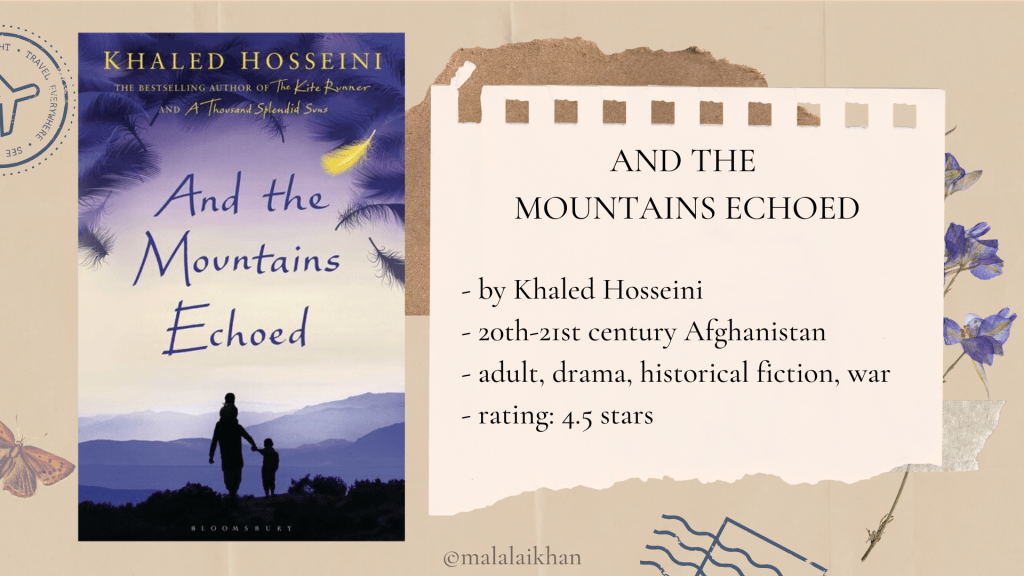
And the Mountains Echoed is Khaled Hosseini’s third book, setting also about the atrocities in Afghanistan.
Khaled Hosseini’s writing, like I said in my previous review of A Thousand Splendid Suns, is very open, honest and clear. He is a master of storytelling.
The story surrounds two siblings, three-year-old Pari and ten-year-old Abdullah, who had lost their mother when Pari was born. Presently, their father Saboor has remarried Parwana to whom lqbal was born. Abdullah and Pari are inseparable; their stepmother takes little care of them, and so Abdullah has the role of playing with Pari and bringing her up.
But one day, Saboor decides to sell Pari to a wealthy childless family.
And that’s where all other narratives start.
Criticizing the language, it basically flows like poetry.
The tiny poem/lullaby of the sad little fairy, reflecting Pari’s name which means fairy in Farsi and Pashto, is so sad and yet beautiful because that is exactly what happens:
“I found a sad little fairy
Beneath the shade of a paper tree.
I know a sad little fairy
Who was blown away by the wind one night.”
Okay, let’s get with the plot.
First the cons: I found myself a bit skim-reading through the narratives of Nabi, Idrees, Adel and adolescent Pari Wahdati. They lacked something, I don’t know, plus I loathed Timur.
Now the pros: Nila Wahdati’s character was conflicting BUT her call for equality of women’s rights is outstanding. I LOVED Markos’s narrative a lot and Pari 2’s as well. Isabelle’s profession as a cellist is SO AESTHETIC and loved her a lot. Suleiman’s love for Nabi was such a huge plot twist. Wow.
What this book most probably mirrored was the difference of social treatment and freedom in the various countries, and how some refugees eventually lose their language and ties to their motherland.
“You say you felt a presence, but I only sensed an absence. A vague pain without a source. I was like a patient who cannot tell the doctor where it hurts, only that it does.”
“A story is like a moving train: no matter where you hop onboard, you are bound to reach your destination sooner or later.”
“He said that if culture is a house, then language was the key to the front door; to all the rooms inside. Without it, he said, you ended up wayward, without a proper home or a legitimate identity.”
Breaking down, I give this a 4.5:
⭐⭐⭐⭐/5
This book reminded me of all the freedom and happiness that Afghanistan was thriving in before the rise of extremism; even now, I sometimes search up photographs of that golden era, the prosperity and peace.
I hope that you read it as well, and become aware of the terrible time that Afghans face.
“Kabul is a thousand tragedies per square mile.”
❤

 malalai khan
Dare to disturb the universe?