Admittedly, I am not a huge fan of Romantic and Victorian poetry. I mean, it is lovely and all, but I wouldn’t rank it in my top favourites. HOWEVER, there are some poems that made me think twice about that. And yes, the themes are dark—surprise. That includes “My Last Duchess” but I will write about that some other day. Hopefully. Right now, we will be talking about religious guilt through the Biblical lens—how exciting! Anyway, the following was my assignment for the Romantic and Victorian Poetry course last semester. I genuinely loved it.
Unlike other Romantic poets such as William Wordsworth, Samuel Taylor Coleridge embeds morality and sin in his poetry, especially in “The Rime of the Ancient Mariner.” Published in 1798 in the first edition of Lyrical Ballads, Coleridge explores the deep feelings of guilt and the harsh voyage to redemption through the narration of the sailor who commits a seemingly illogical crime—killing an albatross—and must endure punishment by the forces of nature. Through vivid imagery and supernatural elements, Coleridge creates a moral story that examines the psychology of guilt and the possibility of spiritual renewal.
The poem begins with the mariner stopping a wedding guest and entrancing him with his tale of a sea journey towards the South Pole, describing the grand beauty of the ocean. However, he disrupts the whole balance of nature by committing a strange and unnecessary act of killing an albatross, a bird that had been seen as a good sign by the ship’s crew. This simple action—“With my cross-bow / I shot the Albatross”—has major consequences, both for the mariner and for the people around him. The crew had believed the bird was holy, saying they “hailed it in God’s name.” So, the mariner’s action is not just a mistake, but also taken as a serious offense against nature and God.
At first, the crew is perplexed about the meaning of this act. When the fog clears after the bird’s death, they think the killing was justified, “Twas right, said they, such birds to slay, / That bring the fog and mist.” However, the moral confusion quickly shifts when the weather changes again and the ship becomes stuck in a windless sea. To punish him, they hang the dead albatross around his neck: “Instead of the cross, the Albatross / About my neck was hung,” blaming the mariner for their suffering. This is a very powerful image for it replaces the Christian cross with the dead bird, showing that the mariner now carries the weight of his sin instead of Christ’s sacrifice. It becomes a symbol of guilt and irreversible fate that he cannot escape.
As the poem continues, Coleridge shows how sin affects the mariner both mentally and physically as the ship is stranded and still in the middle of the ocean: “Water, water, every where, / Nor any drop to drink.” This line reflects the deep irony of the sailors’ situation—surrounded by water, but dying of thirst, which also represents the mariner’s inner torment for he is surrounded by life but feels detached and after some time, it is heightened as the entire crew dies. His guilt has separated him from both humanity and nature.
In this terrible state, the mariner reaches a low point where he is so desperate that he drinks his own blood in order to speak: “I bit my arm, I sucked the blood, / And cried, A sail! a sail!” This strange act of passion can be understood as a form of sacrifice. In Christian belief, the shedding of blood is closely connected with the idea of atonement for Jesus Christ gave his blood to save humanity from sin. By drinking his own blood, the mariner makes a painful and personal sacrifice, portraying how far he has fallen and how much he is suffering to survive. It can be seen as a turning point, where he starts to take responsibility for what he did, just as Christ took the burden of human sin. Though the mariner is not a Christ figure himself, this moment reflects Christian themes of redemption through sacrifice.
Furthermore, the mariner’s punishment strongly echoes other biblical narratives of transgression and divine judgment. Like Cain who killed his brother Abel, the mariner must bear a visible mark of his sin as he wanders the earth. Cain was cursed to be “a fugitive and a wanderer on the earth,” just as the mariner is condemned to roam endlessly, compelled to tell his tale to those he encounters. The line “He prayeth well, who loveth well / Both man and bird and beast” parallels God’s concern for all creations that Cain violated. Similar to Cain, whose punishment included being cast out from society, the mariner experiences profound isolation, becoming “alone on a wide wide sea” with “a thousand thousand slimy things” as his only companions. (Domazetović 76–82)
Moreover, the parallel to Adam and Eve is equally striking. Just as they committed the original sin in Eden by eating the forbidden fruit, the mariner commits his sin through an act of transgression against nature’s harmony. Adam and Eve’s punishment included expulsion from paradise and the burden of mortality; similarly, the mariner is cast out from normal human society and forced to endure a living death-like state. The poem describes how “The bodies of the crew, the dead / Swayed up and down like me,” positioning him between life and death much as fallen humanity exists in a state of spiritual death according to Christian doctrine. The thirst the mariner experiences mirrors the loss of Eden’s abundance, where Adam and Eve had all needs met before their fall.
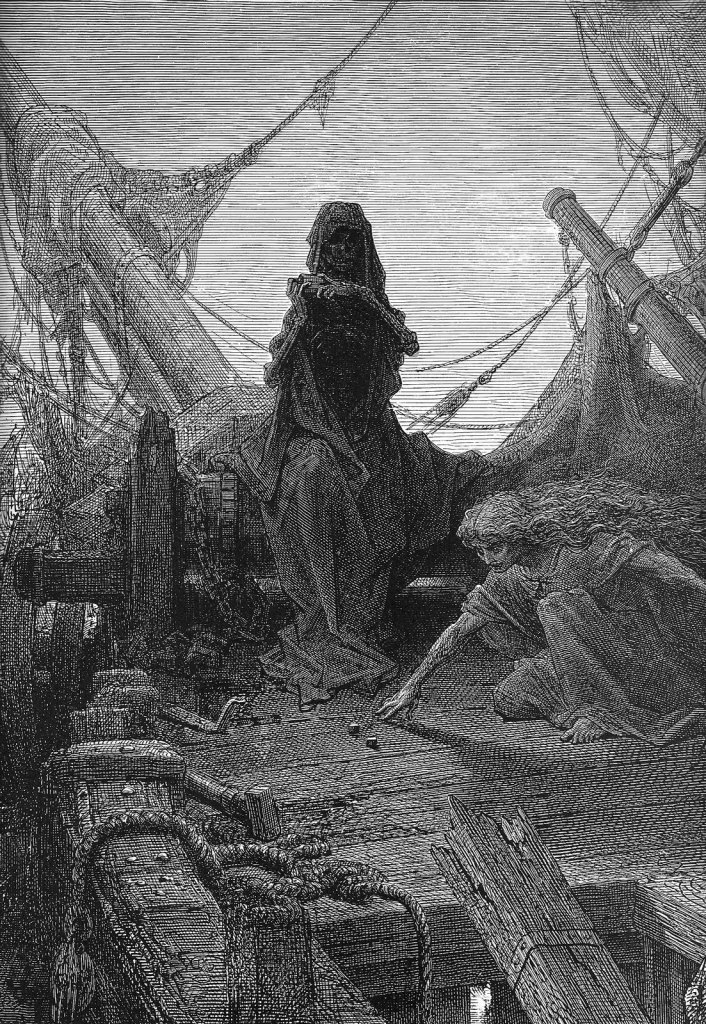
Later in the poem, there is a major turning point when the mariner begins to see beauty in the natural world again. At first, he hated the sea creatures but something changed inside him, and he began to appreciate their beauty: “O happy living things! no tongue / Their beauty might declare.” This spontaneous admiration shows a shift in his heart and without thinking, he blesses them: “A spring of love gushed from my heart, / And I blessed them unaware.” This moment is important because it is not planned or forced—it comes naturally, illustrating that true redemption starts when we feel sincere love and respect for creation.
Right then, the mariner experiences a symbolic unburdening when “The Albatross fell off, and sank / Like lead into the sea,” marking the beginning of his forgiveness. Yet this represents only a step in his redemption, not its completion, as he must continue his journey and accept his new purpose of sharing his tale with others who need to hear it. His suffering transforms into a teaching mission, where he must impart the wisdom gained through his experience after his encounter with the hermit whom he asks for forgiveness, “O shrieve me, shrieve me, holy man!”
The poem concludes with the mariner revealing his hard-won insight to the wedding guest: “He prayeth best, who loveth best / All things both great and small,” emphasizing that true spiritual devotion lies in respecting all of God’s creation. This moral epiphany comes not from theological study but from his painful personal journey. The mariner’s guilt evolves into a perpetual duty to wander and share his story, transforming his transgression into a cautionary tale that leaves the wedding guest “a sadder and a wiser man,” demonstrating how one person’s redemption can lead to others’ enlightenment.
In a nutshell, Coleridge presents guilt not just as punishment, but as a force that can lead to growth and change. The mariner’s long journey portrays that redemption is not easy for it requires suffering, reflection, and a complete evolution in how a person sees the world. Through vivid imagery, Christian symbolism, and emotional language, Coleridge shows that redemption means more than just being forgiven—it means being transformed. The mariner’s guilt leads him to a deeper understanding of life, nature, and the importance of compassion. In the end, his story is not just about personal failure, but about how that failure can become the beginning of wisdom.
x
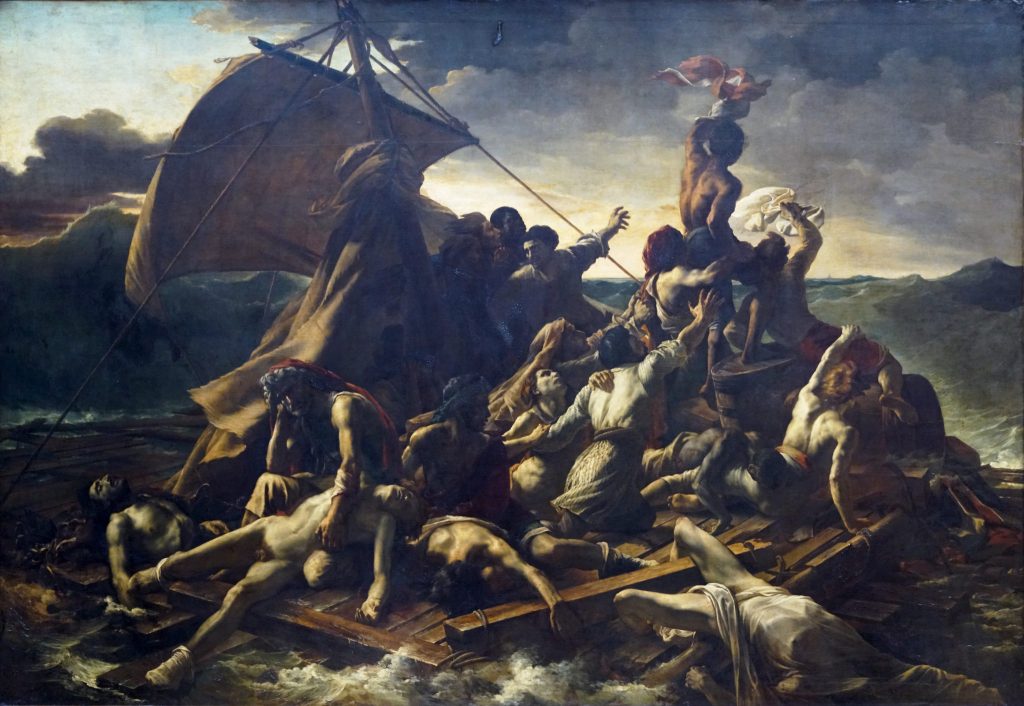
(Featured Image: Raft of the Medusa by Théodore Géricault, 1818–19)
 malalai khan
Dare to disturb the universe?